
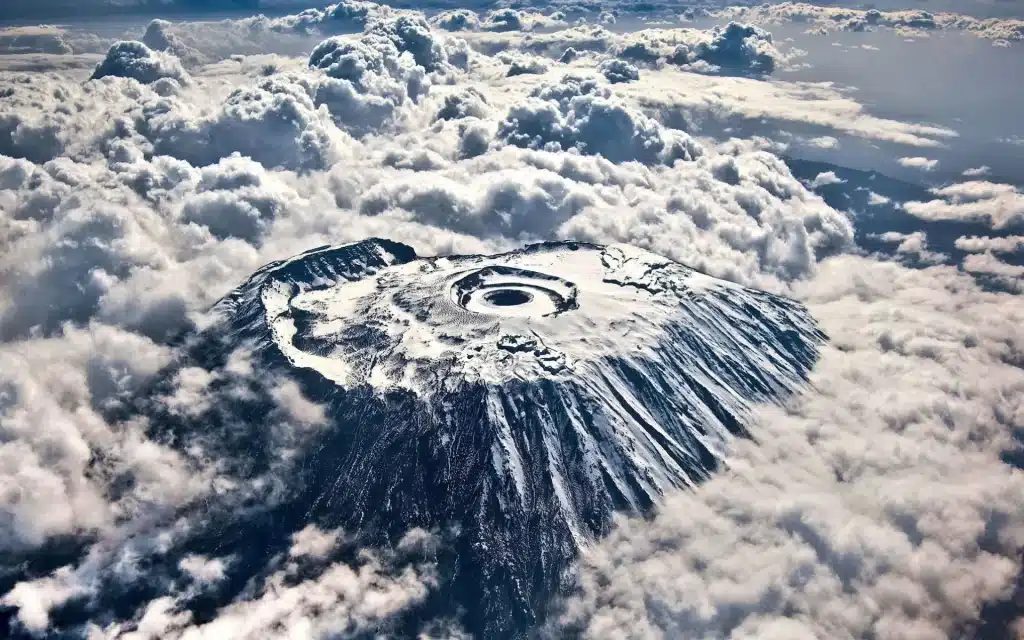
Yes, there is now ice and glaciers at the peak of Mount Kilimanjaro, but significantly less than in the past. As you make the last walk to the summit cone, you can see a spectacular glacier, and the trail itself is snow-covered.
Current Situation (2026-2027)
- The summit (Uhuru Peak, 5,895 m / 19,341 ft) is covered by a shrinking glacier and snowfields.
- You will almost always encounter snow and ice on the final summit push, especially from Stella Point to Uhuru Peak.
- The amount varies by season:
- Dry seasons (Jan–Mar, Jun–Oct) — More snow/ice possible.
- Wet seasons — Can be icy but sometimes less snow cover.
Important Context
- Kilimanjaro’s glaciers have lost over 80% of their volume since the early 20th century due to climate change.
- The famous Furtwangler Glacier near the crater is still visible but much smaller.
- Crampons are rarely needed on standard routes, but trekking poles and good grip on boots help on icy sections.
What climbers experience:
- Cold summit night (often -15°C to -25°C with wind chill).
- Snow underfoot on the last 1–2 hours to the summit.
- Beautiful views of the crater and remaining ice cliffs.
Where do the snow and Ice come from on Kilimanjaro?
The snow and ice on Mount Kilimanjaro come from precipitation (mainly rain and snow) that falls on the mountain and accumulates at high altitudes.
How it forms
Kilimanjaro is located very close to the equator (about 3° South), yet it has permanent snow and glaciers because of its extreme height.
- Moisture Source
The mountain intercepts moist air from the Indian Ocean. Trade winds and seasonal monsoons bring large amounts of water vapor. - Orographic Lift
As the moist air rises up the slopes of the mountain, it cools rapidly. This causes condensation and heavy rainfall on the lower and middle slopes (rainforest and moorland zones). - Snowfall at High Altitude
Above ~4,500–5,000 m, temperatures drop below freezing. The moisture that reaches these heights falls as snow instead of rain. Over time, this snow compacts into ice, forming glaciers and snowfields.
Why It Persists
- The summit is cold enough year-round to preserve snow and ice.
- However, climate change is causing rapid melting — Kilimanjaro has lost most of its ice volume over the last century.
Interesting Fact: Almost all the moisture comes from the Indian Ocean side (southeast). The northern slopes are much drier, which is why some routes feel more arid.
In short: The snow and ice are the result of the mountain forcing moist ocean air to rise, cool, and drop its water — first as rain lower down, then as snow and ice near the top.
- “The Snows of Kilimanjaro” ; Ernest Hemingway’s African safari story from 1936
- Does Africa get snow?
- Sun Protection Guide for Kilimanjaro – Sunscreen, Lip Balm, Snow Blindness Prevention, and More
- Snow-capped Kilimanjaro, flying safari rally car and amazed Maasai in Kenya, the story of the legendary WRC photo
- Why is Mount Kilimanjaro covered with snow at the summit?
- Ice cover on Kilimanjaro increases steadily to 5.92 square kilometres, almost triple the past size
- Do you need crampons, ice axes and spikes to climb Mount Kenya and Rwenzori?
- How cold is Mount Kilimanjaro at each zone including the top summit, Uhuru Peak
- How cold is it at the top of Kilimanjaro?

